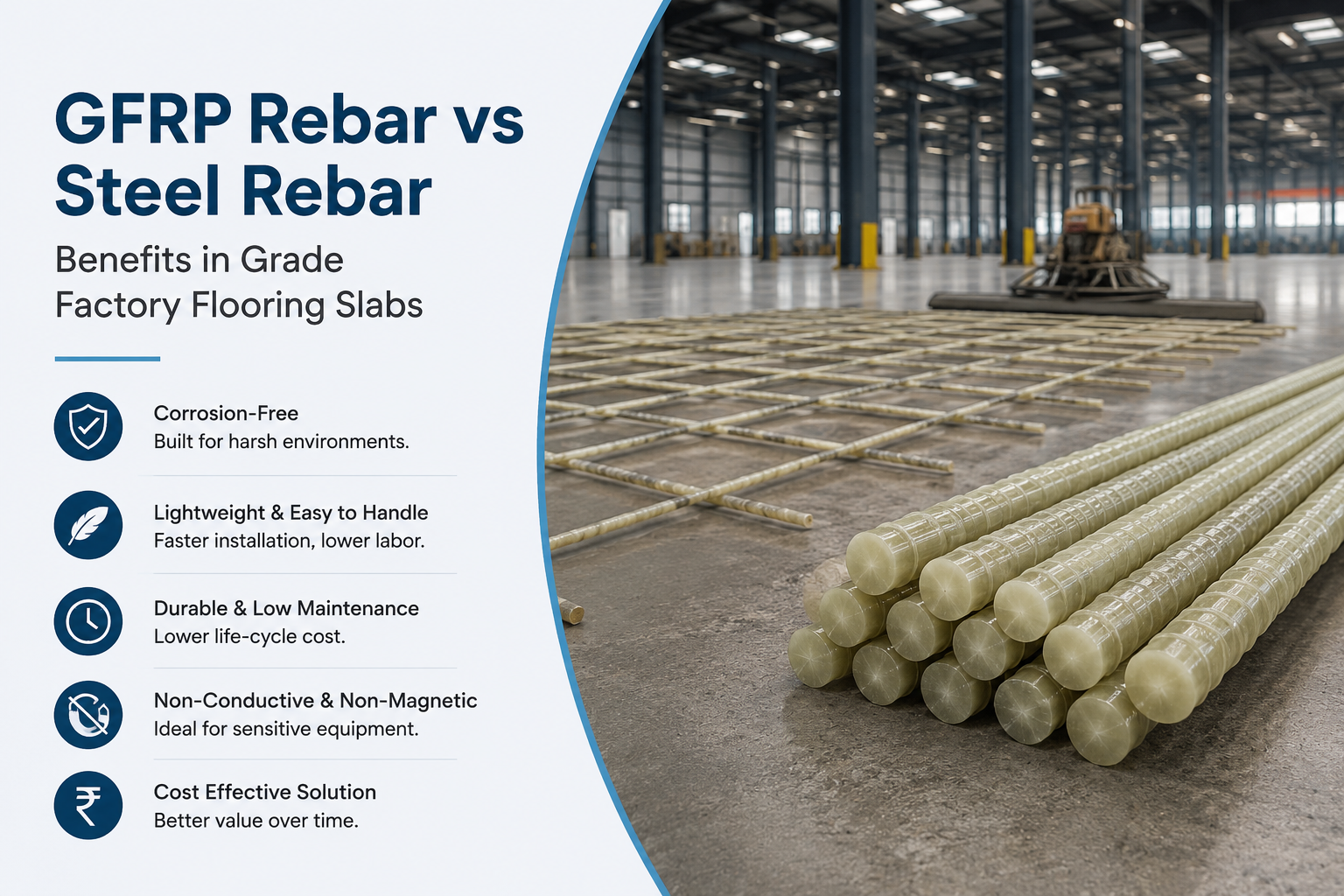
Benefits in Grade Factory Flooring Slabs
Non-corrosive reinforcement for durable, low-maintenance industrial floors
| Core proposition: GFRP reinforcement eliminates the risk of reinforcing-bar corrosion while providing a lightweight, electrically non-conductive and non-magnetic solution for concrete factory floors. |
Prepared by Titan Technovators
GFRP Reinforcement Solutions | August 2026

GFRP Rebar Approved by:
Executive overview
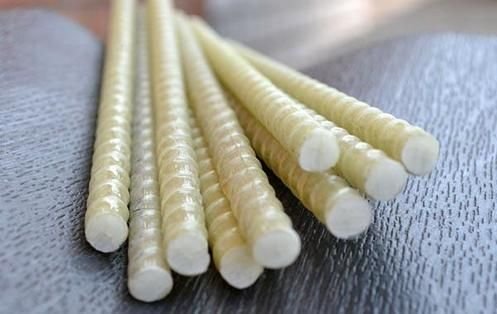
Industrial slabs-on-grade carry wheel, rack and equipment loads while facing impact, abrasion, wash-down, moisture and sometimes chemicals. Water and aggressive agents can reach conventional steel through cracks, joints or damaged surfaces, creating corrosion-related maintenance risk. Titanbar GFRP rebar is nonmetallic and does not rust, helping suitable factory floors achieve durable, lower-maintenance reinforcement.
| Best-value use case: The commercial advantage is strongest where corrosion, process interruption, hygiene, electromagnetic sensitivity or difficult reinforcement handling creates a measurable life-cycle cost for the owner. |
Why factory floors are demanding
- Moisture and chemicals: wash water, salts, oils, cleaning agents and process chemicals may enter through cracks or joints.
- High operational consequences: repairs may require production shutdown, traffic diversion, dust control and equipment relocation.
- Concentrated loading: forklift wheels, rack legs, machine foundations and storage systems generate local stresses.
- Serviceability requirements: joint performance, crack width, flatness, curling, abrasion and surface finish often matter as much as ultimate strength.
Core advantages of GFRP reinforcement for Grade slab
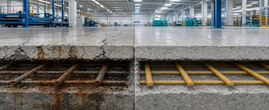
- Corrosion-free reinforcement: no electrochemical rusting, even when moisture reaches the bar.
- COST Effective:– GFRP rebar is approx. 40% cheaper than the steel conventional rebar. In term of Material, labor, transport.
- Reduce number expansion joint: the number of expansion joint will be reduced by 4 time than the steel floor
- Saving in lap length: GFRP rebar up to 8 mm can supply in customized length in coil form which will result in saving in lap length.
- Higher tensile strength: GFRP rebar has more than double tensile strength (above 1200 MPA) than the tensile strength of steel.
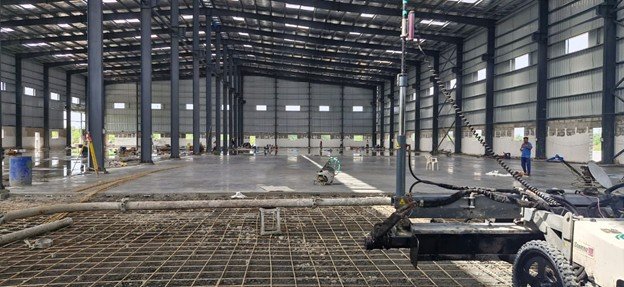
- Save in Construction time: Since it is lighter weight, the fixing time will reduce drastically.
- Improved durability in aggressive exposure: valuable in wet, coastal, chemical and frequent wash-down environments.
- Lower maintenance disruption: reduced risk of corrosion-induced cracking, staining, delamination and repair shutdowns.
- Lightweight handling: as the rebar is 4 time lighter than the steel, easier manual transport, positioning and site logistics than steel reinforcement.
- Electrically non-conductive and non-magnetic: useful around sensitive equipment and specialized industrial processes.
- Life-cycle value: potential savings arise from durability and avoided downtime—not simply from comparing purchase price per kilogram.
- Reduction of potential threat to theft. As reselling of this material at scrapper shop is not accepted the chances of theft are drastically reduced.
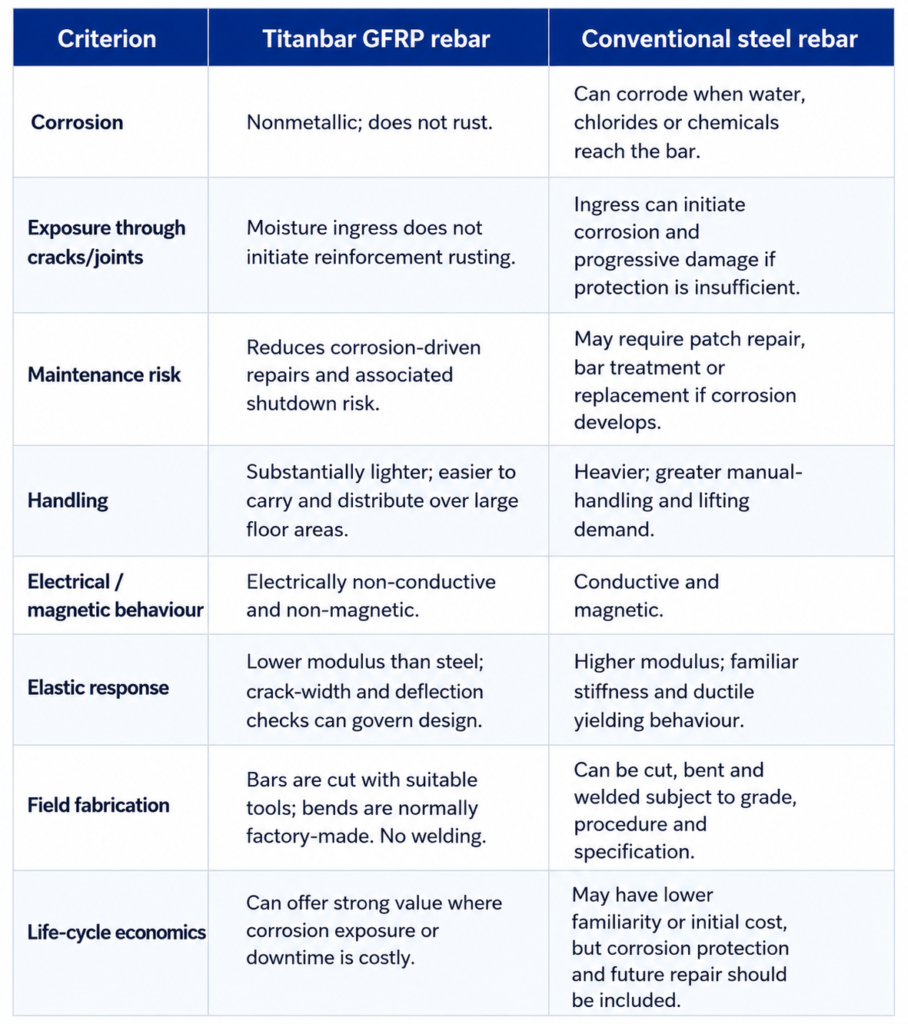
GFRP vs steel in factory flooring slabs
The table below compares the practical implications of each reinforcement type. Final selection must be based on project-specific structural and serviceability design
Where GFRP creates the most value
GFRP can be considered for general industrial flooring, with especially strong value in the following environments:
- Chemical and process plants: Where acids, alkalis, salts, wash water or process liquids increase the risk of steel corrosion. Resin compatibility and exposure limits must be verified.
- Food, beverage and pharmaceutical facilities: Where frequent cleaning, wet service and hygiene requirements make rust staining and repair disruption undesirable.
- Coastal and high-humidity factories: Where airborne salts, high humidity and moisture exposure create persistent corrosion risk.
- Cold storage and refrigerated facilities: Where condensation, wash-down and temperature cycling place added demand on slab detailing. Insulation, joints and thermal movement remain design-critical.
- Electrical, electronics and test facilities: Where electrically non-conductive and non-magnetic reinforcement can help manage electromagnetic or stray-current constraints.
- Battery, EV and energy facilities: Where process exposure, electrical sensitivity or strict maintenance planning can make nonmetallic reinforcement attractive.
- Water and wastewater facilities: Where sustained moisture and chemical exposure make corrosion resistance a primary durability objective.
- Large warehouses and logistics floors: Where lighter reinforcement can simplify movement across large slab areas and corrosion-free reinforcement can reduce long-term risk in wet zones.
Performance implications for the owner
- More predictable durability: corrosion is removed as a reinforcement deterioration mechanism.
- Cleaner finished appearance: no rust bleeding from reinforcement and lower risk of corrosion-related surface distress.
- Reduced intervention risk: fewer corrosion-driven repairs can mean less dust, noise, traffic restriction and production interruption.
- Asset-level economics: evaluation should consider installed labour, corrosion protection, future repair, facility access and downtime.
Installation and quality controls
- Store and lift correctly: Support bundles, protect from damage and excessive UV exposure, and follow the manufacturer’s handling instructions.
- Do not field-bend straight bars: Use factory-fabricated bends where required; avoid heat bending.
- Use suitable cutting tools and PPE: Control glass-fibre dust and protect workers’ skin, eyes and lungs in accordance with the approved method statement.
- Maintain bar position: Use compatible chairs, spacers and ties; prevent flotation or displacement during concrete placement.
- Control concrete construction: Joint timing, placing, consolidation, finishing and curing directly affect floor serviceability and cannot be compensated for by reinforcement selection.
Standards and technical references
[2] ASTM D7957/D7957M-22 – Solid Round GFRP Bars for Concrete Reinforcement
[3] ACI PRC-360-10 – Guide to Design of Slabs-on-Ground
[4] ACI 302.1R-15 – Guide to Concrete Floor and Slab Construction
[5] IRC 137:2022 provides comprehensive guidelines for the use of glass fibre-reinforced polymer (GFRP) bars in reinforced concrete structures for road projects in India.
Contact Titan Technovators
Technical and product enquiries: +91 63 5454 8738 | info@titantechnovators.com
Website: www.titantechnovators.com
Disclaimer: Preliminary guidance only; not a structural design, approval, warranty or substitute for project drawings, specifications, geotechnical information, code review or engineering judgement. Verify product suitability, properties, exposure limits and detailing for each project.
about
Titan Technovators
At Titan Technovators, we embarked on our journey with a simple yet powerful idea: to provide sustainable solution to the Construction Industries.