
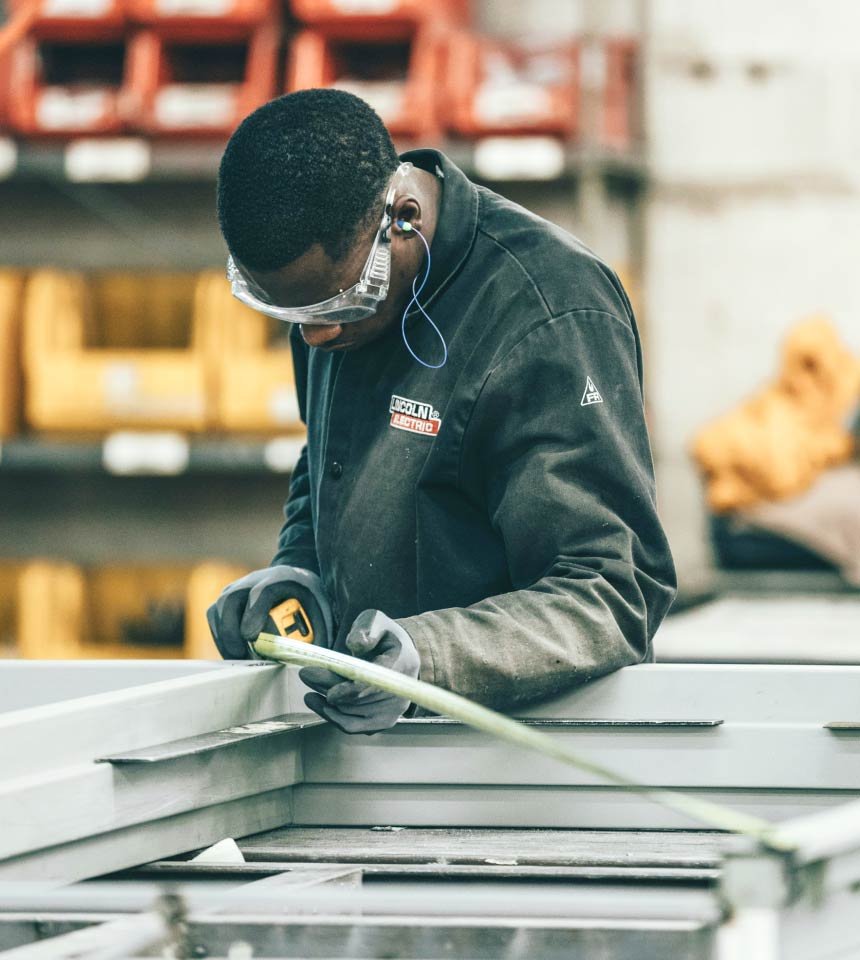
our approach aimed at maximizing productivity & efficiency.
modern ways of manufacturing products.
GFRP Mesh Supplier for Bulk Orders
Glass fibre resin polymer (GFRP) mesh provides surface support coverage to loose rocks between installed bolts. Suitable for temporary and permanent solutions, this low-weight FRP mesh is ideal for decreasing risks associated with manual handling.
This GFRP mesh complies with standard grid applications while providing the added benefits of durability and cuttability. The high load capacity at each joint, comparable to welded steel mesh, is unique and makes the design of grid-reinforced RC structures a viable option. Available in a range of sizes to suit individual applications.
comparison of GFRP Rebar Vs Steel Bar
| Characteristics | GFRP Rebar | Steel Bar |
|---|---|---|
| Corrosion resistance to aggressive environments | Non-corrosive | Corrosive |
| Electric conductivity | Non-conductive | Conductive |
| Conductive | High Non-conductive | Low |
| Thermal conductivity | Low | High |
| Strength at stretching, MPa | 1300 | 390 |
| Compressive Strength, MPa | 550 | 400 |
| Transverse Shear Strength, Mpa | 220 | 300 |
| Bond strength to concrete, Mpa | > 20 | > 12 |
| Ultimate strain, % | 1.5 – 2% | 15% |
| Modulus of elasticity, Gpa | 65 | 160-200 |
| Density, kg/m3 | 2100 | 7800 |
| Working temperature range, ºС | –70…+160 | –70…+50 |
| Magnetic properties | Diamagnet | Conductor |
| Durability | Not less than 80 years | According to building codes |
predictive machines
Fusce dui est ultricies nec ultricies acd porttitor quis tellus ned.
certified factory
Fusce dui est ultricies nec ultricies acd porttitor quis tellus ned.
service related FAQ’s
While on-site bending is not possible, GFRP rebars can be bent during the manufacturing process.
While certain care must be taken while storing Titan Bar (GFRP) on site, it is easy.
- DO NOT store Titan Bar (GFRP) in direct sunlight for longer period. ALWAYS store in shade. Whereas, storing GFRP rebars under rain has no effect as the material does not corrode
- DO NOT drag Titan Bar (GFRP) on ground or across sharp edges.
- ALWAYS use proper hoisting equipment and multiple lifting points when handling linear (for size 12mm and above), non-linear and bent Titan Bar (GFRP)
Products made of glass fibre reinforced polymer have a high durability and can withstand many years without compromising their structure. Polymers age very slowly, In addition, external influences such as humidity, heat or UV rays hardly deteriorate their properties and they are extremely resistant in aggressive environments.
GFRP rebars are 1/4th weight of steel rebars due to the composite materials used in manufacturing, making its density only about 1900 kg/cu.m.
On-site cutting can be done using carbide or diamond-coated blades, which are specifically designed to handle the high strength and durability of GFRP rebar or reinforcement bars like Titan Bar (GFRP). Low speed of cutting is recommended for cleaner cuts.