
The Manufacturing Process of GFRP Rebar: What You Need to Know
Glass Fiber Reinforced Polymer (GFRP) rebar is quickly becoming a preferred choice in the construction industry due to its durability, lightweight properties, and superior corrosion resistance compared to traditional steel rebar. But what goes into making this innovative reinforcement material?
In this blog, we’ll take an in-depth look at the manufacturing process of GFRP rebar—from raw materials to the final product—explaining the steps that ensure its quality, reliability, and performance in concrete structures.
- The Raw Materials Used in GFRP Rebar
The manufacturing of GFRP rebar begins with two key components:
- Glass Fibers: These are the primary reinforcing material in GFRP rebar. High-quality glass fibers, such as E-glass (electrical-grade) or AR-glass (alkali-resistant), are chosen for their high tensile strength and resistance to environmental factors.
- Polymer Resin: The glass fibers are bonded together with a polymer resin, typically epoxy, vinyl ester, or polyester resins. The resin acts as a binding agent and protects the fibers from damage and corrosion.
Together, these materials create a composite that is lightweight yet incredibly strong, making it ideal for concrete reinforcement.
- Pre-Treatment of Glass Fibers
Before production begins, the glass fibers undergo a pre-treatment process to ensure optimal performance.
- The fibers are coated with a sizing agent, which improves their adhesion to the polymer resin during the manufacturing process.
- This step enhances the bond between the fibers and the resin, ensuring the final GFRP rebar can withstand high tensile forces.
Proper pre-treatment is critical for achieving the durability and mechanical properties required for construction projects.
- The Pultrusion Process: Core of GFRP Rebar Production
The heart of GFRP rebar manufacturing is a process called pultrusion. Pultrusion is a continuous, automated process that creates high-strength composite materials with a consistent cross-section, such as rebar.
Here’s how the pultrusion process works step-by-step:
- Feeding the Glass Fibers: Bundles of glass fibers, also known as “rovings,” are fed into the pultrusion machine. These rovings are aligned to provide the required tensile strength and consistency.
- Impregnation with Resin: The glass fibers pass through a resin bath, where they are fully saturated with the polymer resin. This ensures that the fibers are completely bonded and protected.
- Shaping the Rebar: After impregnation, the fibers are pulled through a heated die that shapes the material into the desired rebar diameter. The die also removes any excess resin to create a smooth, uniform product.
- Curing: Inside the heated die, the resin undergoes a curing process. The heat triggers a chemical reaction that hardens the resin, solidifying the composite structure. This step is critical to achieving the strength and durability of GFRP rebar.
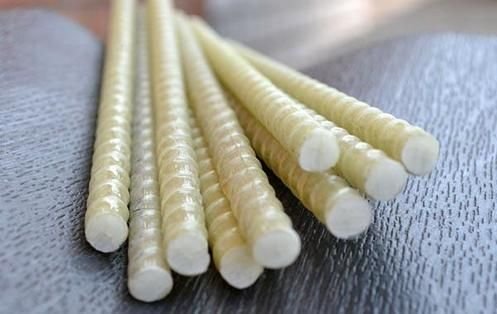
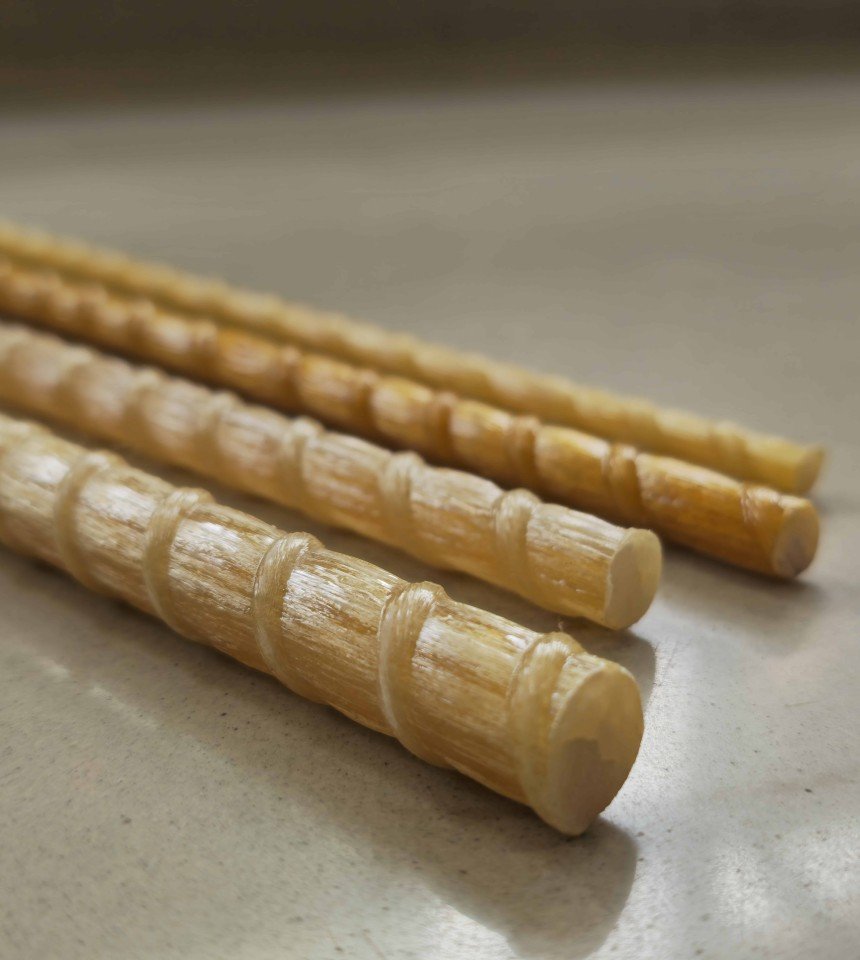
- Adding Surface Texture: To ensure proper bonding with concrete, the GFRP rebar is often given a surface texture during or after curing.
- This can involve adding a sand coating or creating spiral deformations on the surface.
- The textured surface allows the rebar to interlock firmly with concrete, similar to how steel rebar functions.
- Cutting to Length: Once the cured GFRP rebar exits the die, it is cut to the desired lengths using automated cutting tools. This ensures precision and consistency across all batches.
- Quality Control and Testing
To ensure the reliability and performance of GFRP rebar, strict quality control measures are implemented throughout the manufacturing process.
- Dimensional Testing: The diameter, length, and surface texture of the rebar are measured to ensure they meet industry standards.
- Tensile Strength Testing: Samples of GFRP rebar are tested for their tensile strength to confirm they meet design specifications.
- Bond Strength Testing: The bond between the GFRP rebar and concrete is evaluated to ensure proper load transfer.
- Durability Testing: GFRP rebar is tested for resistance to corrosion, chemicals, and harsh environmental conditions.
These quality checks ensure that every piece of GFRP rebar produced is durable, reliable, and compliant with global construction standards.
- Packaging and Transportation
Once the GFRP rebar has passed all quality checks, it is carefully packaged for transportation. Since GFRP rebar is significantly lighter than steel, it reduces fuel consumption during shipping, further contributing to its sustainability.
The rebar is:
- Bundled securely to avoid damage during transit.
- Shipped to construction sites or distributors in ready-to-use form.
- Advantages of the GFRP Manufacturing Process
The GFRP rebar manufacturing process offers several key advantages over traditional steel rebar production:
- Lower Energy Use: The pultrusion process consumes less energy compared to the energy-intensive production of steel.
- Minimal Waste: The continuous process generates little to no waste material, promoting efficiency and sustainability.
- Consistency and Quality: The automated nature of pultrusion ensures a uniform product with reliable mechanical properties.
These factors contribute to making GFRP rebar a high-quality, environmentally friendly alternative to steel.
Why the Manufacturing Process Matters
The precise manufacturing of GFRP rebar is what makes it such a game-changing material in construction. Its unique production process ensures:
- Corrosion Resistance: The resin-coated glass fibers provide long-lasting protection against moisture and chemicals.
- High Strength and Lightweight: GFRP offers impressive tensile strength while being up to 75% lighter than steel.
- Reliability: Rigorous testing guarantees that GFRP rebar performs under extreme conditions, making it suitable for marine, coastal, and chemical environments.
By understanding how GFRP rebar is manufactured, engineers, contractors, and project managers can appreciate the science and quality behind this advanced material.
Conclusion: Innovation for Durable and Sustainable Construction
The manufacturing process of GFRP rebar—from raw glass fibers and resin to the final textured product—is a testament to innovation and precision. Through the advanced pultrusion process, GFRP rebar achieves unmatched durability, strength, and resistance to harsh environments, making it the ideal choice for modern construction.
Whether you’re working on coastal infrastructure, bridges, or chemical plants, GFRP rebar ensures a longer service life with minimal maintenance and maximum reliability.
Ready to Learn More About GFRP Rebar?
At Titan Technovators, we pride ourselves on producing high-quality GFRP rebar that meets the highest industry standards. Contact us today to learn how our products can enhance the durability and performance of your construction projects.
Build Smarter. Build Stronger. Build with GFRP Rebar
about
Titan Technovators
At Titan Technovators, we embarked on our journey with a simple yet powerful idea: to provide sustainable solution to the Construction Industries.